
Fall line to the coast
Barndominium Builders in South Carolina
Barndos planned for red clay, Sandhills sand, wet flatwoods and 115 to 150 mph wind zones.
- Free on-site land visits
- Written, line-item estimates
- County wind and permit research included
Building Barndominiums Across South Carolina
Barndominium builders in South Carolina have to plan for two very different states at once: the hilly red-clay country above the fall line and the flat, sandy, often wet Coastal Plain below it, with hurricane winds rising as you near the ocean. We build barndominium homes, kit packages, metal building homes, custom barndominiums and shop houses for landowners across the Midlands, the Pee Dee, the Grand Strand, the Lowcountry and the York and Lancaster area.
One statewide code, many local rules
South Carolina's Building Codes Council adopted the 2021 codes on October 6, 2021, and set January 1, 2023 as the date local jurisdictions had to begin enforcing them. The 2021 South Carolina Residential Code (the 2021 IRC with state modifications) is mandatory for every county and municipality, so a barndominium home gets permits and inspections whether it is in a city or out in an unincorporated county. The energy code is different: the 2009 IECC is set by state law (Act 143), not by the Council.
What changes from place to place is the paperwork and the design loads. Horry County, for example, asks for sealed engineering under the 2021 IRC, a wind design summary sheet, floor plans, elevations, two site plans and an energy sheet for a new house.
Wind is the big design number
State rules tell builders to use the Council's published wind maps, and they let the local building official set the wind design category within that jurisdiction. The difference across the state is large. The Council's map lists all of York County at 115 mph. Goose Creek's design criteria call for 140+ mph. The City of Charleston designs to 150 mph. Steel frames, roof panels, doors and windows are all ordered for the number on your permit, and the code requires a continuous load path that carries uplift from the roof down to the foundation.
Septic comes before the building permit
On land without public sewer, the state's Department of Environmental Services has to approve and permit a septic system first; without it, the county will not issue a building permit. Clemson Extension's guide describes the steps: apply online with the plat or deed, pay the application fee, clear brush, stake the house footprint and wait in a first-come, first-served queue for the site evaluation. Above the fall line, a backhoe pit is required for that evaluation. We help you get the site ready so the evaluator can see what they need.
Heat, humidity and steel
Most of South Carolina is humid subtropical, with summer highs near 90 degrees and nights near 70. Charleston averages about 73 percent relative humidity across the year. Warm, wet air against cool steel is how condensation starts, so insulation, air sealing and HVAC sizing are part of our plan from the first sketch, not an afterthought.
What a project looks like
- Land visit and a check of soils, drainage and access
- County research: zoning, wind category, flood zone and septic path
- Floor plan and written, line-item estimate
- Septic permit, building permit and site prep
- Slab, shell erection and dry-in
- Insulation, mechanicals and interior finish-out
Where We Build in South Carolina
We build across the parts of South Carolina below and east of the Upstate, and each region asks for something different.
The Midlands and the fall line
Columbia sits right on the fall line, where the hilly Piedmont ends and the Coastal Plain begins. North and west, around Chapin, Newberry and Greenwood, the ground is Piedmont country: gently rolling to steep, with red clay subsoils like the Cecil series, which is kaolinite clay with mica under a sandy loam topsoil. That clay drains slowly, so we watch grading and where roof water goes. The Midlands also have the state's record heat, 113 degrees at USC Columbia in 2012, and freezing rain is more common than snow around and southeast of Columbia.
The Sandhills
A band of old wind-blown sand runs through the inner Coastal Plain, around Lexington, Camden, Aiken and North Augusta. Soils like the Blaney series carry about two feet of sand before reaching sandy clay. The sand drains fast and builds easily, but it needs care at slab edges and around downspouts so water does not wash it out.
The Pee Dee and the Coastal Plain
Around Florence, Darlington, Hartsville, Sumter and Orangeburg, the land flattens into the state's farm belt. Many Coastal Plain soils are poorly drained, with better ground on sandy ridges and slopes. South Carolina also has about 5,000 mapped Carolina bays: shallow, oval depressions that may hold a pond or swamp or sit dry. On flat, wet ground, house pad height and drainage matter as much as square footage.
The Grand Strand and the Lowcountry
From Conway and Loris through Georgetown, Charleston, Summerville, Walterboro, Beaufort and Bluffton, the land is nearly level flatwoods, marsh edges and sea islands. Wind design climbs here (Goose Creek uses 140+ mph and Charleston 150 mph), Charleston's frost depth is zero, and Goose Creek rates termite hazard as heavy. Flood maps decide a lot: in Horry County, a house in a flood plain needs a pre-construction elevation certificate, and VE zones have their own requirements.
York and Lancaster counties
Rock Hill, Fort Mill, York, Lancaster and Chester sit in the Piedmont near the North Carolina line. The state's map puts York County at 115 mph wind and seismic category B, lighter loads than the coast, with red clay ground that needs the same attention to drainage as the rest of the Piedmont.
- Barndominium Builders in Columbia, SC
- Barndominium Builders in Lexington, SC
- Barndominium Builders in Irmo, SC
- Barndominium Builders in Chapin, SC
- Barndominium Builders in Camden, SC
- Barndominium Builders in Sumter, SC
- Barndominium Builders in Orangeburg, SC
- Barndominium Builders in Aiken, SC
- Barndominium Builders in North Augusta, SC
- Barndominium Builders in Florence, SC
- Barndominium Builders in Darlington, SC
- Barndominium Builders in Hartsville, SC
- Barndominium Builders in Myrtle Beach, SC
- Barndominium Builders in Conway, SC
- Barndominium Builders in Loris, SC
- Barndominium Builders in Charleston, SC
- Barndominium Builders in Summerville, SC
- Barndominium Builders in Moncks Corner, SC
- Barndominium Builders in Goose Creek, SC
- Barndominium Builders in Walterboro, SC
- Barndominium Builders in Beaufort, SC
- Barndominium Builders in Bluffton, SC
- Barndominium Builders in Rock Hill, SC
- Barndominium Builders in Fort Mill, SC
- Barndominium Builders in York, SC
- Barndominium Builders in Lancaster, SC
- Barndominium Builders in Chester, SC
- Barndominium Builders in Newberry, SC
- Barndominium Builders in Greenwood, SC
Barndominium Services
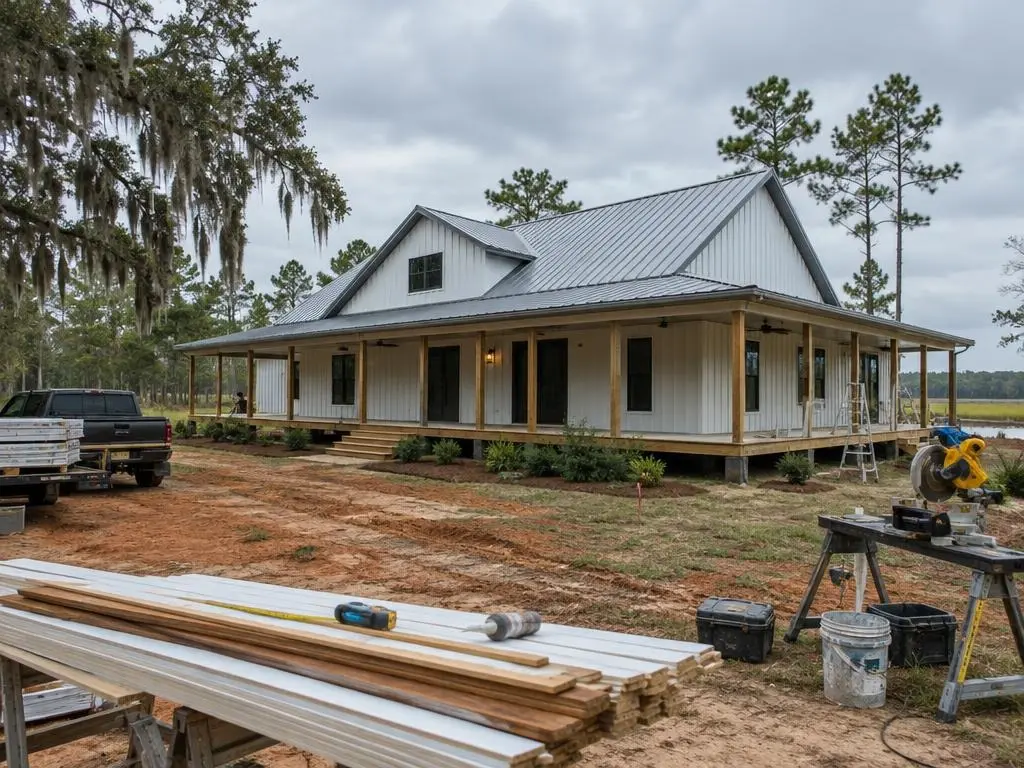
Six ways to build a barndominium on South Carolina land, from a kit shell to a finished home with a shop.
Barndominium Homes
Finished barndominium homes, from land visit and septic permit to the last coat of paint.
Learn more →Barndominium Kits
Steel or post-frame kit packages ordered for your county's wind rating, delivered and erected.
Learn more →Barndominium Floor Plans
Floor plans drawn around South Carolina heat, porches, shop bays and your county's site rules.
Learn more →Metal Building Homes
Steel-framed homes engineered for coastal wind, heavy termite pressure and humid summers.
Learn more →Custom Barndominiums
One-off barndominiums for coastal lots, flood zones, wooded acreage and owners with a specific vision.
Learn more →Shop Houses
Living quarters and a real working shop under one roof, sized for trucks, boats or equipment.
Learn more →Common Questions
How much does it cost to build a barndominium in South Carolina?
It depends on the size, the finish level and the land. Published cost guides price barndominiums per square foot, and the ranges are wide because site prep, septic, a well, wind design and finishes move the total most. Our service pages list typical ranges from named sources, and our written estimate is the price for your project.
Are barndominiums allowed in South Carolina?
Yes, as long as they meet the 2021 South Carolina Residential Code, which every county and city must enforce. The harder questions are local: some zoning districts, historic districts and HOA or deed restrictions limit metal-sided homes. Unincorporated rural land with agricultural or rural zoning is usually the simplest. We check your parcel before design starts.
Do I need a septic permit before a building permit?
If the land has no public sewer, yes. The state requires septic approval and a permit first, and counties will not issue a building permit without it. There is an application fee, and the site evaluation happens in a first-come, first-served queue, so it is one of the first things we start.
What wind speed does a barndominium have to be built for?
It depends on where you build. The Building Codes Council's map lists York County at 115 mph, Goose Creek's criteria call for 140+ mph and the City of Charleston uses 150 mph. Your local building official sets the category, and the frame, roof and doors are engineered for it.
How long does it take to build a barndominium?
Plan on months, not weeks. A shell can go up in a few weeks once the slab is cured, but septic permitting, plan review, site prep and interior finish-out take most of the calendar. Conexwest, a container seller, publishes an estimate of 6 to 12 months for a typical South Carolina build. We give you a stage-by-stage schedule with the estimate.
Can you get a mortgage on a barndominium?
Often, but it takes more homework than a standard house. Many lenders do not offer construction loans, and the appraisal is the usual hurdle because appraisers need comparable sales nearby. USDA loans can cover a barndominium in eligible rural areas if it appraises. Talk to a lender early; we can supply plans and a line-item estimate for them.
Should I worry about hurricanes and flooding on the coast?
Plan for both. Hurricane season runs June through November, and both Hazel in 1954 and Hugo in 1989 hit South Carolina as Category 4 storms. Near the coast, design wind speeds are higher, and in a mapped flood plain you may need an elevation certificate before construction and a raised floor. We check the flood map for your parcel first.
Is steel or wood framing better for a barndo here?
Both work. Steel frames clear-span wide buildings without interior posts and do not rot, which matters where termite hazard is rated heavy, as it is in Goose Creek. Post-frame (wood) shells are often cheaper at 30 to 40 foot widths and accept ordinary insulation. We price both when it makes sense for your plan.
Why Homeowners Call South Carolina Barndominium Builders
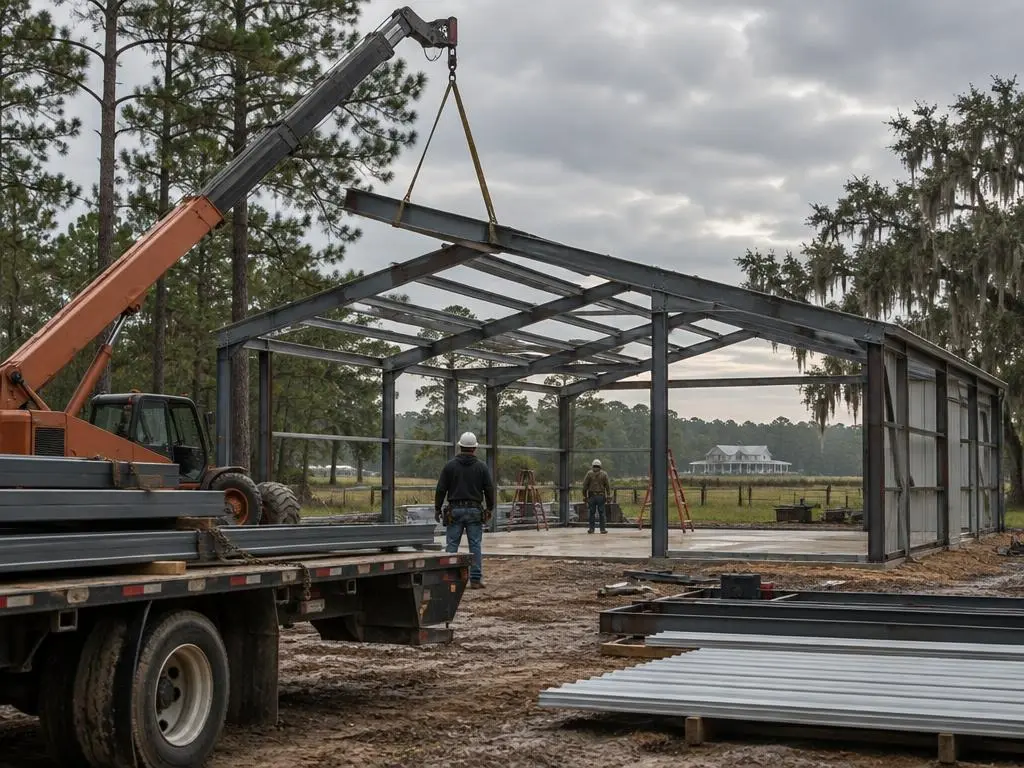
We see the land before we price it
A free visit shows us access for trucks and cranes, standing water, trees, slope and where a septic field could go. Prices built without that visit tend to change later.
Your county's rules, looked up for you
We check zoning, deed or HOA limits, the wind design category your building official uses, the flood zone and the septic path before you commit to a plan.
Line-item written estimates
Site prep, slab, shell, insulation, HVAC, plumbing, electrical and finishes are listed separately, so you can see where the money goes and what you can change.
A condensation plan for humid summers
With summer nights near 70 degrees and coastal humidity in the 70s, we plan spray foam or other insulation, air sealing and right-sized HVAC so moisture does not collect on steel.
Have Land? Let's Walk It.
Book a free land visit and get a written, line-item barndominium estimate.